.png)
Why Snow Beast Performance Doesn't Accept Health Insurance — And Why That's Better for You
Updated: May 23
One of the first questions we get from people considering working with us is some version of: "Wait — you don't take insurance? Why not?"
It is a fair question. Health insurance exists to make healthcare more accessible, and choosing not to participate in that system sounds counterintuitive at first. We get it — we have been on the consumer side ourselves and we know exactly how confusing and frustrating navigating health insurance can be.
But this was not a careless decision. It was a deliberate one, made because we believe it produces better outcomes for our clients and allows us to practice the kind of physical therapy we went to school to provide.
Here is the full story.
If you want a detailed breakdown of how the costs and care quality of cash-based and insurance-based physical therapy compare side by side, read our post on cash-based vs. insurance physical therapy. This post focuses specifically on why Snow Beast Performance made this choice — and what it means for you as a client.
What Out-of-Network Actually Means
Out-of-network means we are healthcare providers who are not contracted with any insurance company. We do not bill insurance directly, and insurance companies do not set the terms of your care with us.
That is the definition. Here is what it means in practice.
Insurance Controls More of Your Care Than You Realize
When a physical therapy clinic is contracted with insurance companies, the insurance company becomes a silent third party in every clinical decision. Not in a theoretical sense — in a very literal, operational one.
Insurance limits how many visits you are approved for. It dictates which procedures can be billed and how often. It determines what conditions qualify for continued treatment and when care must stop. It requires physician referrals, pre-authorizations, follow-up appointments, and documentation that consumes enormous amounts of clinician time.
We have worked in insurance-based settings. We have experienced firsthand what it feels like to have a client who is making genuine progress — who is motivated, engaged, and on track — and have that progress interrupted because an insurance policy says the approved visits are exhausted. Or to have a treatment approach we know would help be denied because it does not fit the coverage criteria.
That experience is frustrating for the clinician. It is demoralizing for the client. And it produces worse outcomes than care that is allowed to run its full, clinically appropriate course.
By operating out of network, none of those constraints exist. We see you as often as clinically indicated. We work on what actually needs to be worked on. We continue care through the full arc of your recovery — from initial pain relief through return to sport and into performance training if that is where your goals take you. No arbitrary stopping points determined by a policy.
The 15-Day Problem
A study I came across a few years ago reported that the average time from injury to physical therapy treatment — when going through the traditional insurance-based referral pathway — is 15 days.
Think about what that pathway looks like. You get injured. You call your primary care physician and wait for an appointment. You go in, describe your symptoms, and get referred to a specialist. You wait for that appointment. You see the specialist, who orders imaging. You wait for the imaging appointment. You go back to the specialist to review results. You finally get referred to physical therapy.
Fifteen days. Four or more appointments. Multiple co-pays. Significant time spent waiting in offices and on hold with insurance companies. And at the end of all of it, you still have not received a single minute of actual physical therapy treatment.
During those 15 days, your body has been compensating. You have been moving differently to avoid pain, which loads other structures unevenly. What started as a straightforward injury has had two weeks to become more complicated. You may have needed medication to manage pain during that window — which addresses the symptom but does nothing for the underlying problem.
At Snow Beast Performance, that entire pathway is eliminated. You call us, you come in, and we start working on the problem — often on the same day or within a day or two.
In Vermont, physical therapy has direct access — meaning you do not need a physician referral to see us. We are qualified to evaluate your condition, determine what is going on, and identify if and when you need to be referred to another provider for imaging, specialist care, or medical management. Most of the time, none of that is necessary. When it is, we tell you clearly and connect you with the right person.

What You May Have Experienced at an Insurance-Based Clinic
If you have been to physical therapy before through insurance, some of these experiences may be familiar.
Your therapist was working with two, three, or four clients simultaneously. You spent significant time with an aide or exercise technician rather than with the physical therapist directly. Your sessions were 15 to 20 minutes of actual hands-on time despite being billed as hour-long appointments.
This is not a criticism of the clinicians in those settings — it is a criticism of the financial reality those settings create. High-volume, multi-patient care is how insurance-based clinics remain financially viable given the reimbursement rates insurance companies pay. It is a rational business response to an irrational reimbursement system.
But it is not the kind of care we want to provide — and we believe it is not the kind of care you deserve.
At Snow Beast Performance, every session is one-on-one with your clinician for the full duration of your appointment. We do not have aides or assistants because we do not need them — we are not managing four clients at once. The person who evaluated you is the person treating you, every time.
By structuring our practice this way, we leave revenue on the table compared to a high-volume insurance model. We are genuinely comfortable with that trade-off. The relationship we build with clients, and the outcomes we produce, are worth more to us than the volume.
The Deductible Reality
The financial argument for using insurance assumes your insurance is actually paying for a meaningful portion of your care. For many people with current plan structures, that assumption does not hold.
Over the past decade, insurance premiums have increased significantly. Deductibles have increased even more. Wages have not kept pace with either. The result is that many people are spending more on insurance than ever before while simultaneously being responsible for more out-of-pocket cost before their benefits activate.
If your deductible is $3,000 or $5,000 and you have not met it yet, you are paying the full contracted rate at an in-network clinic — which can be $150 to $350 per session depending on the billing codes used. You may not find this out until you have already completed several sessions and receive a bill weeks later.
At Snow Beast Performance, our pricing is transparent and you know it before your first appointment. There are no surprise bills. And for clients with out-of-network benefits, we provide a Superbill that can be submitted to insurance for reimbursement — many clients receive 50 to 80 percent back after meeting their out-of-network deductible.
Two Paths — One Clear Difference
The out-of-network path means fewer visits needed to reach your goal, more time with your clinician per session, greater transparency on cost, and no administrative barriers between you and the care you need.
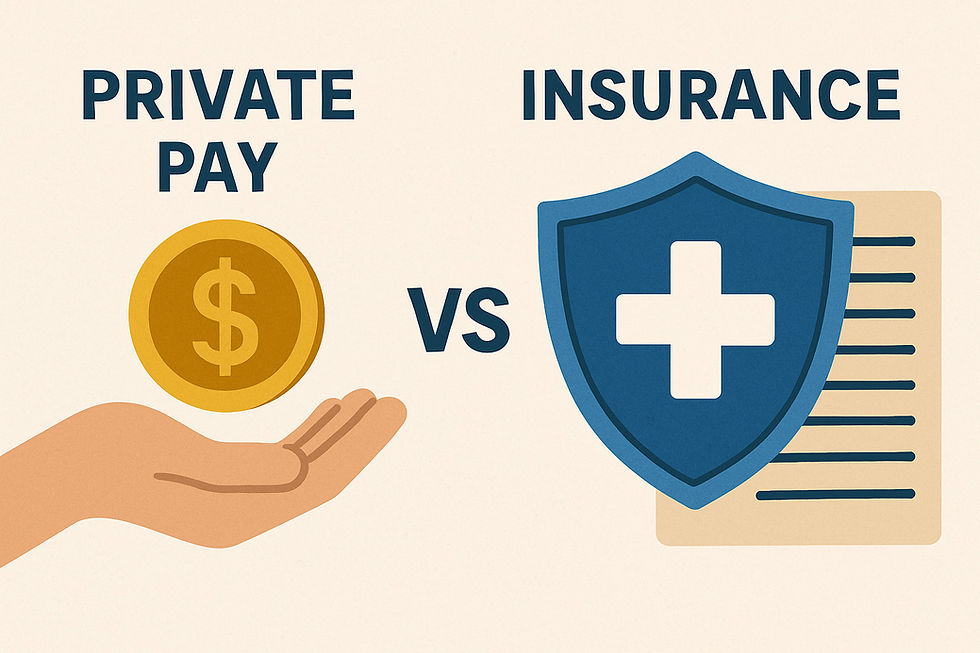
The in-network path offers the familiarity of using insurance — but often at a higher true cost and lower quality of individual attention than most people expect going in.
Why This Model Works for Outdoor Athletes in Vermont
The clients we work with at Snow Beast Performance are active adults who value their physical capability and want to keep skiing, running, hiking, and training for as long as possible. Their goals do not stop at pain relief — they want to return to full performance, stay there, and build the resilience to do it across a lifetime of seasons.
That kind of long-term, performance-oriented care is almost impossible to deliver within an insurance-based model. Insurance covers injury treatment. It does not cover the performance training, ongoing manual work, and preventive care that keeps an active 45-year-old on the mountain year after year.
Out of network, we can do all of it — under one roof, with one clinician who knows your history, your goals, and your body.
Starting With Snow Beast Performance in Williston, VT
Every new client begins with a free 15-minute discovery call. We listen to your story, explain exactly how our model works, answer your questions about cost and coverage, and make sure we are the right fit for each other before anyone commits to anything.
If you still have questions about how our out-of-network model compares to insurance-based care, we are always happy to have that conversation in detail. Reach out directly — this is something we could talk about all day.
You can also explore our physical therapy services to understand the full scope of what we offer, or get started with a discovery call when you are ready.
FAQ: Out-of-Network Physical Therapy in Vermont
What does it mean that Snow Beast Performance is out of network? It means we do not have a contract with any health insurance company. You pay us directly for services rather than billing through insurance. In exchange, you receive care that is determined entirely by your clinician and your goals — not by what a policy will authorize. We accept credit card, HSA, FSA, check, and cash.
Do I need a referral to come to Snow Beast Performance? No. Vermont is a direct access state for physical therapy, which means you can schedule directly with us without seeing a physician first. If your evaluation reveals that you need medical care, specialist consultation, or imaging beyond what physical therapy addresses, we will refer you appropriately.
Can I still get reimbursed by my insurance if I come to Snow Beast Performance? Possibly — it depends on your plan. Many insurance plans include out-of-network benefits that cover a portion of out-of-network care after an out-of-network deductible is met. We provide a Superbill upon request that you can submit to your insurance company for reimbursement. We recommend calling the member services number on your insurance card and asking specifically about your out-of-network physical therapy benefits before your first appointment.
Is out-of-network physical therapy more expensive than going through insurance? Not always — and frequently less so when you account for the full picture. High deductible plans mean many patients pay $150 to $350 per session at in-network clinics until their deductible is satisfied. Our pricing is transparent, known upfront, and often comparable or lower than the true out-of-pocket cost of in-network care for patients who have not met their deductible.
Why do insurance-based physical therapy clinics see multiple patients at once?
Insurance reimbursement rates are set by the insurance company at levels that make one-on-one care financially unsustainable for high-volume clinics. Seeing multiple patients simultaneously allows clinics to generate enough revenue to operate within those reimbursement constraints. At Snow Beast Performance, our out-of-network model allows us to see clients one-on-one for every session without the financial pressure that drives multi-patient scheduling.
What happens if I need more sessions than I initially planned for? There is no cap. We continue care for as long as it is clinically indicated and as long as you want to keep working toward your goals. Many clients transition from injury rehabilitation into ongoing performance training, monthly maintenance sessions, or seasonal check-ins — all on their own terms, with no insurance company determining when the relationship ends.
Written by Stephen Burkert, DPT — Snow Beast Performance, Williston, VT


Comments